
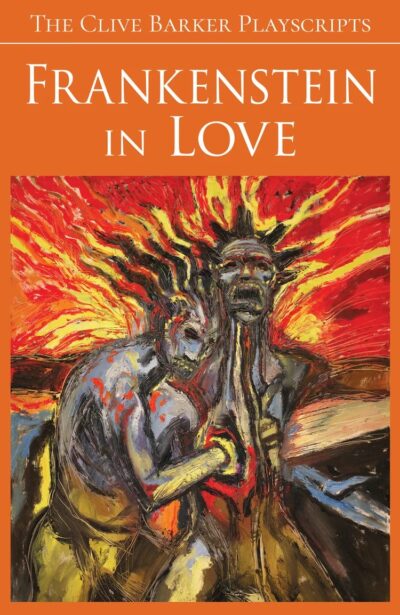
By CLIVE BARKER (The Clive Barker Archive; 2021)
In Clive Barker’s preface to this, the most notorious of his pre-BOOKS OF BLOOD plays, he admits that it and his other dramas “are not finished things…They are deliberately free form. They are deliberately overpacked. They are deliberately ragged, unhoned, raw.”
In short, you shouldn’t expect polish or refinement from FRANKENSTEIN IN LOVE, OR THE LIFE OF DEATH. Initially drafted back in 1981, it was, like all of Barker’s plays, performed by his self-created Dog Company on a ridiculously low budget. He claims that “Several audience members were driven from their seats by the intensity of it all,” which I say constitutes a strong recommendation.
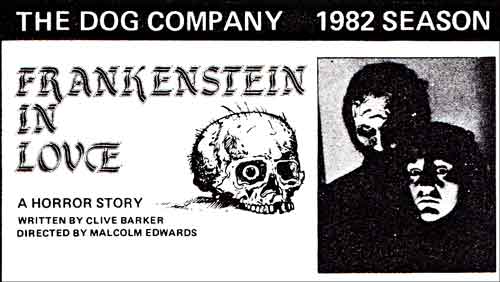
The setting is an unnamed South American dictatorship containing several quirky characters. Included are the disgraced President Garcia Heliodoro Perez, the zombie dancer Maria Reina Duran, the Frankenstein’s Monster figure El Coco (whose “flesh is a patchwork—part red, part black, part white, and badly scarred”), his creator Dr. “Frank” Frankenstein and the latter’s lover Veronique, who happens to be one of his victims.
CARDINAL: But Frankenstein, oh dear Joseph, he always loved humanity.
VERONIQUE: Never.
CARDINAL: Oh yes. He had a passion for its intricacies, its strength, its elasticity. So he wanted to stretch it, shape it, remake it by his own rules. To make a law for the flesh, a physical morality he called it. I just saw a blood-letter, a tormentor. And it pleased me, watching him silence their complaints, sluice out their minds with agonies. I’d put my finger, sometimes, into their hot heads, buried in thought up to the knuckle, and see their lives go out a little further with each prod. That pleased me too. He worked out of love, I out of loathing.
Barker’s later work is prefigured in passages like the one in which El Coco’s skin is flayed a la HELLRAISER and another in which El Coco’s hands become afflicted with a mind of their own a la the INHUMAN CONDITION story “The Body Politic,” as well as a fantasy of how “all the men and women on Earth were one huge beast,” which essentially sums up the BOOKS OF BLOOD story “In The Hills, The Cities,” and an overall affinity for the monstrous that matches Barker’s attitude toward the inhuman protagonists of CABAL (and its filmic iteration NIGHTBREED).
It all leads to the marriage of Frank and Veronique, which occurs in a Presidential Palace decorated with “Rows of mummified heads, their dried faces caught in shrieks and howls, their leather tongues curled and coiled. The stage seems to fill with the dead.” The wedding, as you might guess, is far from standard, marred by torture, a plea by the bride for her spouse to “Show me your heart” (meant quite literally) and a climactic appearance by none other than Death himself.
That appearance is apropos, as death blankets the play, together with its companions disease, deformity and dismemberment. FRANKENSTEIN IN LOVE is said to be among the bleakest of Barker’s works (Barker: “There are some dark journeys taken in BOOKS OF BLOOD, to be sure, but I can’t think of a tale even there that so obsessively circles on images of death and taboo”). The tone, however, is extremely jokey and the political content quite overt, as is evident in Barker’s summation of the play’s arc: “as a country often turns against their leaders, the monster turns against its creator.”
As for myself, I found FRANKENSTEIN IN LOVE tough going. It lacks cohesion and narrative clarity, being a meandering slog whose constant focus on death grows wearying very quickly, and whose relationship to Mary Shelley’s creation is tangential at best (the title character doesn’t even turn up until over halfway through). It’s most interesting in my view as a harbinger of bigger and better things from its author, whose genius had yet to reach full bloom.