
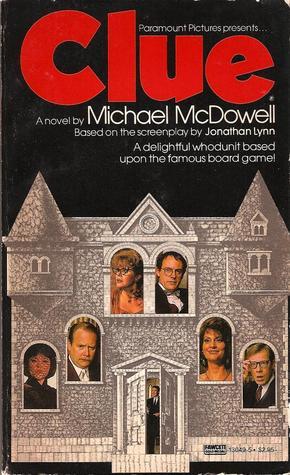
 By MICHAEL McDOWELL (Fawcett Gold Medal; 1985)
One of the more puzzling aspects of modern filmdom is the ascension of CLUE (1985) to cult immortality. A filmed iteration of the similarly titled Parker Brothers board game, the pic was innovative in its day due to the fact that it had four endings that were played in different theaters (the evident hope being that people would pay to see the film multiple times in order to experience all the endings). Having seen it back in ‘85, I can report that despite a strong cast that included Tim Curry, Colleen Camp, Leslie Ann Warren and Martin Mull, CLUE wasn’t much, marred by a caricatured air that placed the whole thing on the level of lame mid-1980s yuk fests like TRANSYLVANIA 6-5000 (1985) and HAUNTED HONEYMOON (1986)—and I say it hasn’t gotten any better in the ensuing decades.
This novelization was penned by the late Michael McDowell. It was the only such book he wrote (as McDowell devoted the remainder of his life to screenwriting), and I think it goes without saying that McDowell, who Stephen King once called “the finest writer of paperback originals in America,” was vastly overqualified. The book is far more gripping than the material deserves, with cheekily refined prose that proves McDowell understood the film’s tone better than its own writer-director Jonathan Lynn.
The setting is the “appropriately if dully named” Hill House in the year 1954. With the anti-Communist hysteria of Senator Joe McCarthy employed as background ambiance (right wing overreach was one of McDowell’s favored subjects), the story involves several eccentric folks invited to Hill House by its butler Wadsworth (played by Tim Curry in the film), who runs the place with Yvette, a “fetishist’s dream of a French maid,” and Mrs. Ho, a “full bodied Chinese woman.”
The invitees, all given names supplied by Wadsworth, include Colonel Mustard, who’s “hale and hearty, and if he had a wife, then the poor woman was probably trampled on, psychologically speaking”; Mrs. White, “beautiful as Desdemona on the night that lady was murdered, pale as Isabella the day she learned her lover was dead”; Mrs. Peacock, a “handsome matron with more than her share of jewels and bosom”; and Professor Plum, described as, simply, “a man.”
What follows is a succession of contrivances derived from the CLUE board game, whose players are tasked with figuring out who committed a murder, where and how. Here each of the participants are given murder weapons by Wadsworth, and then, during a blackout, bodies begin piling up, killed in various ways in the dark (so the killer can’t be seen). Whodunnit?
As in the film, four different endings are provided (announced by a nonfiction aside proclaiming that “the charm of CLUE is derived in part from the many possibilities that exist for a solution to the puzzle”). Each involves the perpetrator cacklingly fessing up to his/her crimes, and the intercession of a door-to-door evangelist with a secret identity, as well as the repeated refrain “said Mr. Green, green,” suggesting that talented though he was, Michael McDowell was wise to refrain from comedy in his other novels.