
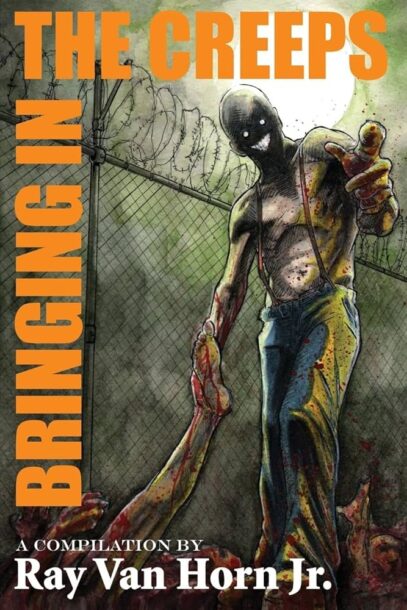
By RAY VAN HORN, JR. (Anuci Press; 2025)
The category of pop culture infused fright fiction can said to have been cornered, quite definitively, by Ray Van Horn, Jr. This was proven by Horn’s previous collection BEHIND THE SHADOWS (2024), and again with BRINGING IN THE CREEPS, which offers a terrifically enjoyable assortment of pop culture inflected spooky tales.
Mass art minutia and horror admittedly doesn’t sound like a terribly invigorating combination, but it works due to the enormous wit and fluidity of Mr. Horn’s prose (“If Armageddon has an actual taste, I think a regurgitated sub with the works is it”), and the subject matter and settings of his narratives, which tend to harmonize quite well with all the name dropping (which includes TRON, horror writer Nancy Collins, COBRA KAI, THE TINGLER and Stephen King). Nostalgia is a primary component of Horn’s fiction, as in a description of an early-1980s video arcade, scored by Journey’s “Don’t Stop Believin’” and containing an unofficial “Makeout Zone,” that will resonate with anyone who was around back then.
“End of Midway” starts the collection off with a satisfying blast (literally) of no-frills nastiness involving a toothy monster lurking around a small town fairground. Also figuring into the story are a vengeance-minded middle-aged man, a helpful sheriff and the immortal line “An agonizing yowl pierces my ears, louder than standing next to Motorhead’s Marshall SuperBass amp at Ozzfest ‘98 without ear plugs.”
A metal milieu likewise powers “Age of Quarrel,” about a malignant presence that turns a concert into “EVIL DEAD raids a punk show,” while the industry that manufactures and markets such music is adroitly skewered in “Widow,” a depiction of a music journalist’s fling with a female punk star that takes a mighty dark turn when some very revealing tattoos are spied on her belly. “Wolf Con,” for its part, takes on the horror convention scene, in which an aging actor known for playing werewolves, who happens to actually be a werewolf, attempts to squelch his baser impulses, while “The Equine of Loch Raven” provides an old school monster mash centered on a kelpie, a shape-shifting monstrosity from Celtic folklore that’s apparently “like that liquid Terminator guy that couldn’t be killed.”
Standout entries include “Run,” which takes the form of an exercise log by Katie, an overweight twentysomething looking to slim down in an account that’s alternately funny and tender—at least until a creepy old fellow periodically spotted by Katie comes to dominate a narrative that grows increasingly bleak. “Chickeerun,” set in 1957, is even stronger, describing a game of automotive chicken, interrupted by a ghostly presence, that’s packed with authoritative detail (bequeathed by the author’s Boomer parents) and nuanced characters, not all of whom are especially likeable.
The final story is “Meteor Shit.” Named after a phrase introduced in the Stephen King scripted (and acted) CREEPSHOW (1982), it offers up a touching, and evidently autobiographical, tale of a persecuted 12 year old in the 1980s with whom many of us will relate, and the nasty revenge he takes on his major tormentor, another eminently relatable element.