
Living through the 21st Century means that, among other things, seemingly every week brings a new FRANKENSTEIN movie. Since the turn of the millennium, we’ve gotten FRANKENSTEIN REBORN (2005), FRANKENSTEIN’S ARMY (2013), I FRANKENSTEIN (2014), VICTOR FRANKENSTEIN (2015), LISA FRANENSTEIN (2024), FRANKENSTEIN (2025) and THE BRIDE! (2026)—and no, there aren’t too many classics to be found in that line-up.
For that matter, the vast majority of 20th Century FRANKENSTEIN films were uninspiring (as anyone who’s sat through FRANKENSTEIN 1970, FRANKENSTEIN MEETS THE SPACEMONSTER or FRANKENSTEIN ISLAND well knows). This all serves to prove two things: 1). That Mary Shelley’s 1818 novel is truly immortal, with a relevance that remains undimmed after two centuries, and 2). Translating that text to the screen isn’t nearly as easy as it might seem.
To date, nobody has ever attempted an entirely faithful adaptation of FRANKENSTEIN; OR, THE MODERN PROMETHEUS, but filmmakers have certainly riffed on it, to varying degrees of success. Here—omitting FRANKENSTEIN (1931), THE BRIDE OF FRANKENSTEIN (1935) and YOUNG FRANKENSTEIN (1974)—are eight especially interesting FRANKENSTEIN inversions that I say are worth your time.
 ALRAUNE
FRANKENSTEIN wasn’t credited as the inspiration for this late period German silent, or the 1911 Hanns Heinz Ewers source novel, but there’s no hiding its influence. There exist several film adaptations of Ewers’ novel, but this 1928 film is the best. It depicts a soulless woman named Alraune (or Mandrake), the product of an experiment in artificial insemination who seduces and drives several men to madness, including her own scientist “father” (Paul Wegener). Writer-director Henrik Galeen plays fast and loose with Ewers’ text (and Mary Shelley’s), but the film’s chilly atmosphere, arrestingly perverse storyline and stunning lead performance by Brigitte Helm (following her legendary turn as the robot woman in METROPOLIS) make for a unique and impacting viewing experience.
FRANKENSTEIN: THE TRUE STORY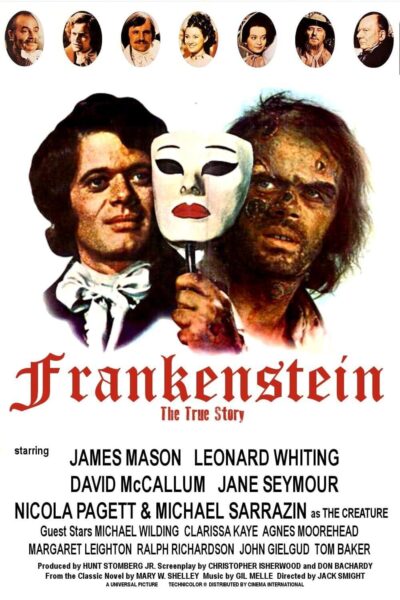
A much-hyped TV movie event from 1973 that I’ve always found a mite overrated. I don’t concur with the widely held view that FRANKENSTEIN: THE TRUE STORY is “one of the greatest fantasy films ever made,” as it contains an unconscionable amount of padding in its three hour-plus whole (originally spread out over two nights). It also has an overtly queer subtext, courtesy of the very gay Christopher Isherwood, who co-scripted the pic with his lover Don Bachardy (meaning all the recent queer/feminist FRANKENSTEIN updatings have long since been rendered passe). Such perverse add-ons tend to grate when visited on a classic text, but Isherwood’s exuberance and invention result in pleasing additions to the story like Frankenstein’s Monster (Michael Sarrazin) beginning as a good looking young fellow who after contracting an unidentified (AIDS-like) virus morphs into an ugly mutant, leading to Dr. Frankenstein (Leonard Whiting) being told that “You loved your creature so long as it was pretty, but when it lost its looks, ha!”
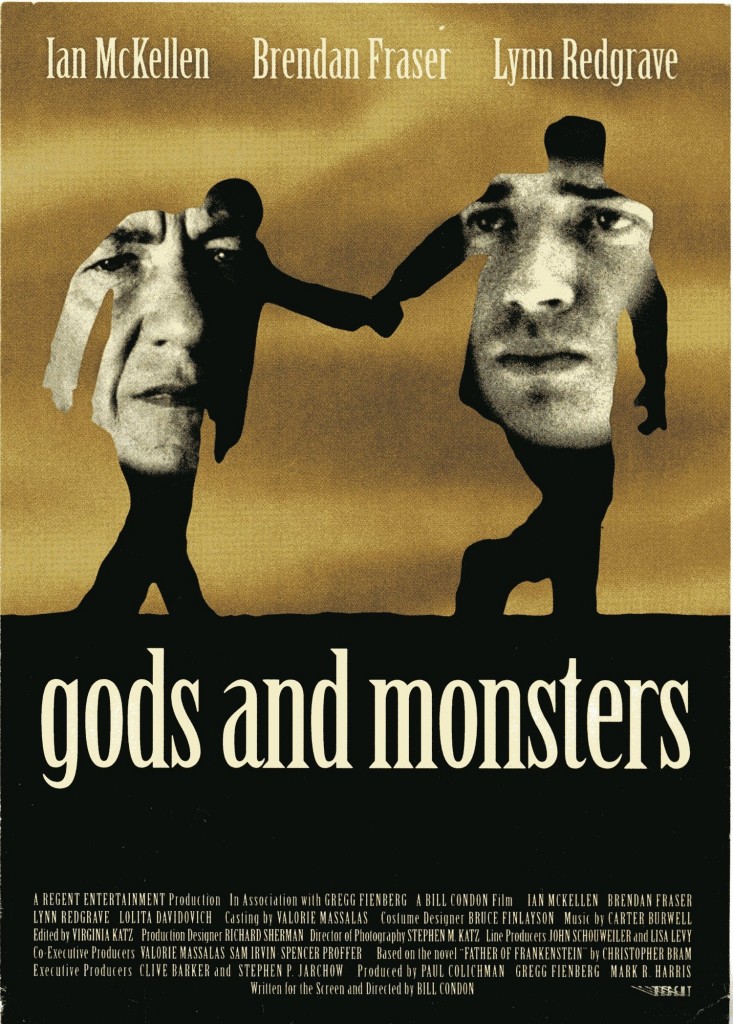 GODS AND MONSTERS
This Clive Barker shepherded film was highly touted back in 1998, but in recent years it’s grown shockingly obscure. Based on a novel by Christopher Bram, it purports to fill in the details of the final days of James Whale, who directed FRANKENSTEIN and THE BRIDE OF FRANKENSTEIN. In GODS AND MONSTERS, the aging Whale (Ian McKellan) becomes involved with a young gardener (Brendan Fraser) he tries to make into his own Frankenstein’s monster who exists to kill its creator, but when the “monster” doesn’t follow through with Whale’s wishes he does the job himself. The film is interesting in the way it morphs from a straightforward indie drama into a dark and expressionistic nightmare, complete with flashing lightning (i.e. a movie directed by James Whale). Throughout it all writer-director Bill Condon keeps the pic, essentially a three character chamber piece, consistently lively and compelling.
GOTHIC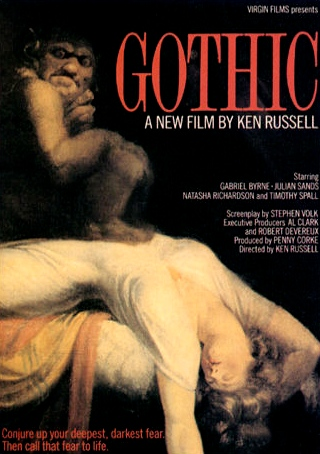
There exist several films about the wild night spent by Mary Shelley (Natasha Richardson), her husband Percy (Julian Sands), Lord Byron (Gabriel Byrne) and John Polidori (Timothy Spall) that led Ms. Shelley to write FRANKENSTEIN (and Polidori to pen “The Vampyre”), including HAUNTED SUMMER (1988) and FRANKENSTEIN AND THE VAMPYRE: A DARK AND STORMY NIGHT (2014), but GOTHIC (1986) is the standout. It was directed by the late British bad boy Ken Russell, and scripted by horror novelist Stephen Volk, who visualize the events of June 16, 1816, in the form of an extended bad trip involving a vampire dwarf, a headless piano playing mannequin, a monstrous undead fetus and a woman with eyes in place of nipples. From a narrative standpoint the film isn’t anything to shout about, and it certainly won’t please those looking for a straightforward history lesson; such things didn’t seem to interest Russell, who here (as he did elsewhere) made no apologies for his love of shock and excess. The cast is as spastic and unfettered as you might expect, with Byrne making quite an impression as the demonic Lord Byron and the late Natasha Richardson, in her film debut, providing a dignified counterpoint to all the craziness.
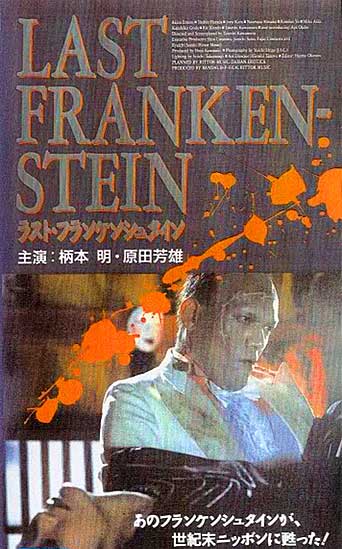 THE LAST FRANKENSTEIN
Japan has turned out a number of FRANKENSTEIN movies, including the Kaiju themed FRANKENSTEIN CONQUERS THE WORLD (Furankenshutain tai Baragon; 1965), but the best such film in my view is THE LAST FRANKENSTEIN (Rasuto Furankenshutain; 1991). Written and directed by the famed avant-garde playwright Takeshi Kawamura, it’s a film that owes something plot-wise to Paul Morrissey’s FLESH FOR FRANKENSTEIN (1973), but I say THE LAST FRANKENSTEIN outdoes it. Set in a post-apocalyptic Japan ravaged by a mysterious suicide virus, the film addresses a number of questions modern readers might have about FRANKENSTEIN: What might Frankenstein’s Monster’s sex life be like? Does the creature watch TV? Go to the beach? LAST FRANKENSTEIN answers all those queries, but it works, ultimately, not because of its similarities with Shelley’s story, but for its dissimilarities and departures—from Shelley and just about everyone else.
THE LIVING THEATER: FRANKENSTEIN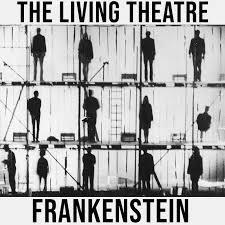
This 1970s-era video, recorded with outdated equipment and defaced by German subtitles, is currently the only way to view a full performance of the legendary Living Theatre staging of FRANKENSTEIN. Patterned on the theories and practices of Antonin Artaud’s Theatre of Cruelty, the Living Theatre FRANKENSTEIN scandalized the 1960s theater world, and this video recording of a European performance amply demonstrates why. Situated in a chaotic multi-tiered structure, the show is awash in onstage brutality, screaming, crucifixion and mass killing. Consistently confrontational and unharmonious, the production’s relationship to Mary Shelley is tenuous, but its dramatic execution is a stunner.
 ROBOT
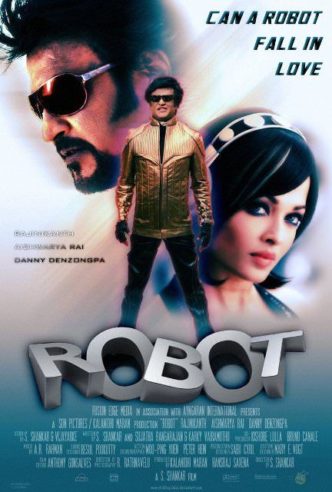
ROBOT
The 2010 Tamil language FX extravaganza ROBOT (ENTHIRAN) is far from a straight FRANKENSTEIN adaptation, but its account of a rogue humanoid (Tamil superstar Rajnikanth) replicates Mary Shelley’s narrative quite faithfully. If you’re like me (which is to say: a Westerner), the ultra-broad slapstick, goofy music numbers and uneasy mixture of practical and CGI effects may seem off-putting at first, but the film, I promise, will win you over with its go-for-broke spirit.
THE SPIRIT OF THE BEEHIVE
Here’s something altogether different: a Spanish made rumination on how FRANKENSTEIN (1931) warps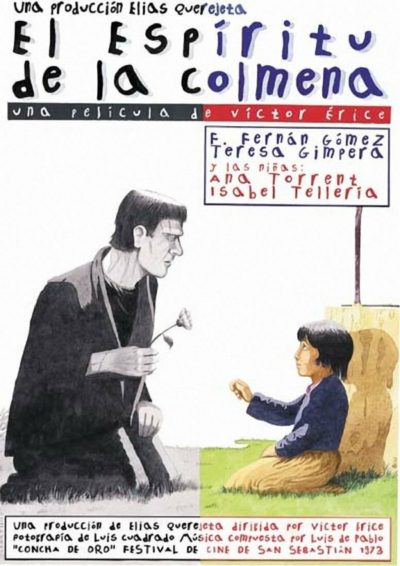 the imagination of an impressionable child. The setting of THE SPIRIT OF THE BEEHIVE (El espíritu de la Colmena; 1973) is a rural Spanish village in the early 1940’s, where a screening of the film in question is held. Among the patrons are the young Ana (Ana Torrent) and her sister Isabel, who find themselves deeply affected. Isabel convinces Ana that Frankenstein’s monster exists as a spirit living in an abandoned shack on the outskirts of the village. Ana goes in search of the monster and discovers instead a wounded Republican deserter; she becomes deeply sympathetic to the man, but he’s tracked down and killed, causing Ana to enter a hallucinatory state where the “spirit” visits her. Although it follows no set perimeters of any sort, writer-director Victor Erice’s filmmaking is stunningly confident and assured. Taken on its own terms (and there’s really no other way to take it), the film is flawless, never compromising its dreamy veneer.